
Walk a Quincy Street Record
A useful Quincy street directory search moves from a place to records, not from an owner label to a guess. Start with the smallest stable facts: house number, street name, and city. The Adams County Property Tax Search accepts those fields and can return the parcel number, tax owner, legal description, tax district, and year. The county advises using a house number with a distinct part of the street when the full address does not match.
- Search the house number and a short, distinct street fragment in Devnet.
- Copy the PIN, site address, legal description, and tax year without changing their form.
- Open the county GIS parcel layer and confirm that the mapped polygon matches the site.
- Use the legal description and owner names to enter the Recorder's deed chain.
- For a dated household, compare a directory, newspaper, census, or voter record that is lawful to use.
This sequence separates what each source proves. A parcel record identifies land and a taxable owner. A deed records a title event. A city directory entry is dated evidence about a listed person. Illinois voter lookup is a self-check, not a tool for browsing everyone on a Quincy street.
Quincy Street Directory Fields
Devnet is the strongest current address-keyed starting point. Its Parcel Search has no separate ZIP field, so use City when needed and read the address in the result. At least one criterion is required. The Mobile Home tab accepts a number with or without dashes. For history work, the tax-year controls matter because online Adams County tax records start with tax year 1999, payable in 2000.
| Search control | Use on a street search | Important limit |
|---|---|---|
| Parcel Number | Returns to one known parcel | Preserve leading zeroes and format |
| Owner Name | Checks the tax-bill name | Owner does not mean occupant |
| House Number / Street Name / City | Finds a place by address | Try a short street fragment |
| Township / Tax Code / District | Narrows local geography | These are not neighborhood names |
| Legal Description | Connects tax and deed records | Street wording may change |
| All Tax Years / Low / High | Compares available tax years | Online coverage begins in 1999 |
The portal's date stamp shows when the system was refreshed, not when each parcel changed. Download or note the year attached to any bill. A label for one tax year may identify taxes payable in the next year.
When a search returns too many parcels, add one narrow field at a time. A township, tax code, or district can reduce the set without forcing a long exact address. If no result appears, remove punctuation and street suffixes before assuming the record is absent. Mobile homes use their own search tab and number field. Save the query terms with the result so another researcher can repeat the same Quincy street directory check and see whether the portal has changed. That record makes later comparisons much easier to verify.
Note: Last name alone may work better than a full owner name when the tax bill uses initials or a formal recorded style.
Quincy Records Searchable by Address
No official Quincy street directory merges all address records. The same street can appear in current parcels, recorded instruments, city address files, permits, or older printed volumes. Use the PIN and legal description to hold the search together when spelling, numbering, or ZIP information changes.
| Quincy source | Address key | What the source establishes | Access channel |
|---|---|---|---|
| Devnet tax parcel | House, street, city, PIN | Tax owner, year, code, legal description | Online from 1999; office for earlier books |
| County GIS | SiteAddress, PIN, polygon | Mapped parcel and selected attributes | Public MapServer or county help |
| Recorder instruments | Legal description, party, book/page | Title parties and recorded events | Tapestry, Laredo, office, IRAD |
| City Engineering | Assigned street address | Address and map context | Phone or office inquiry |
| Directories and newspapers | Printed street form and date | Dated occupant or household clue | QPL, HSQAC, microfilm, digital archive |
City permit and code records may also be keyed by address through the city's iWorQ route, but the research did not establish its full coverage or live search fields. Treat an applicant or permit contact as a role in that filing, not proof of residence.
Map Quincy Streets in GIS
The Adams County GIS MapServer exposes parcel polygons, address points, roads, districts, current aerials, and historical layers. Begin with the subject parcel. Then inspect the SiteAddress, PIN, legal description, owner and mailing fields, tax code, use code, and document link. GIS labels help locate a record; they are not a legal survey.
The county service is especially useful when a Quincy street directory query returns several similar addresses. Parcel boundaries and lot or block data can separate them. A 1938 aerial layer can add old physical context, but it cannot name a household. For a boundary dispute, use the recorded deed, plat, and qualified survey evidence. City Engineering says it does not settle property-line disputes.
The county GIS service and its address layers are shown below.
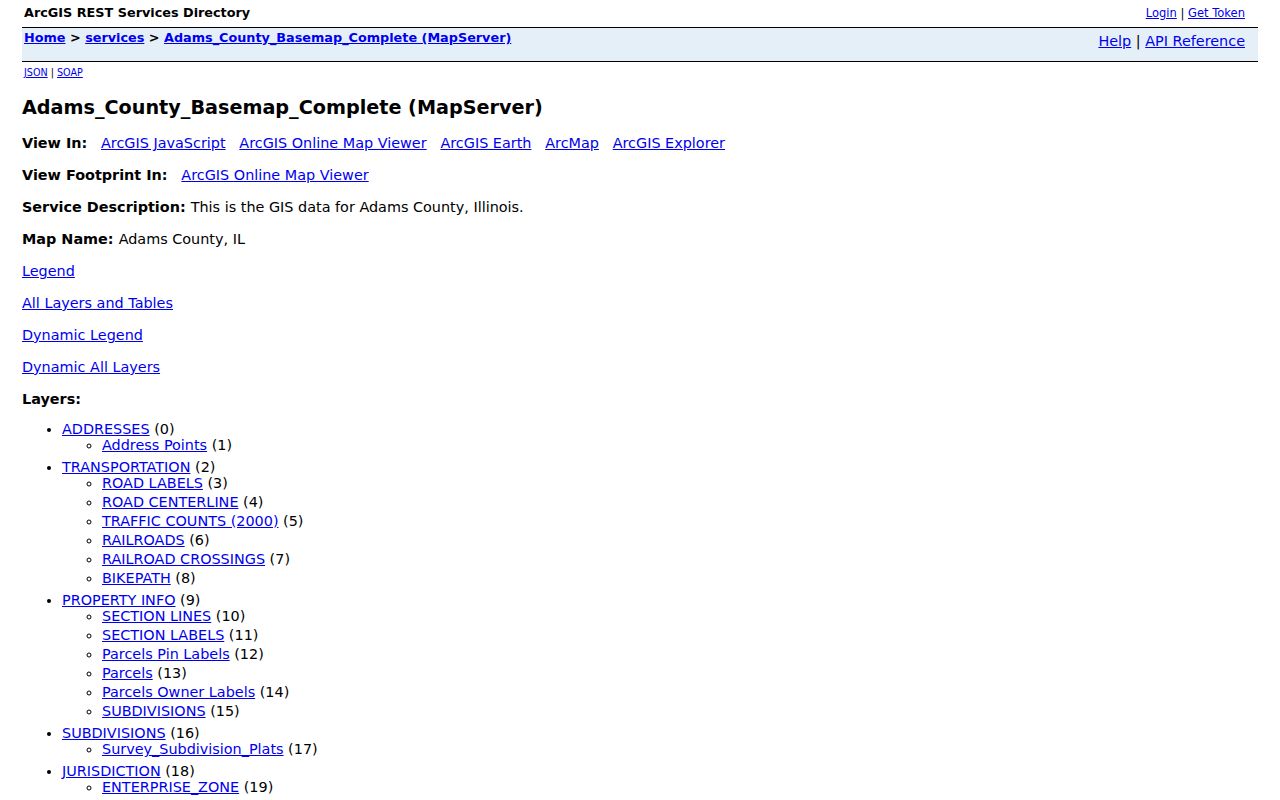
The layer list shows why a mapped address can be checked against both the parcel geometry and the county's other place-based data.
Read Quincy Parcel Terms
Street records use short terms that can change the meaning of a result. Define them before carrying facts from one system to another.
- Parcel or PIN
- A county identifier for a mapped tax parcel. It identifies land, not a person.
- Situs address
- The physical site address of the parcel, which may differ from the tax owner's mailing address.
- Plat
- A recorded map showing lots, blocks, subdivisions, streets, and related boundaries.
- Legal description
- The recorded words that identify land, often by lot and block or by survey terms.
- Criss-cross directory
- A directory organized by street or address so a reader can find a listed person from a place.
A public parcel query for 608 Adams Street illustrates the difference. It returns a site address, PIN, Woods Survey lot and block, owner fields, and a mailing address elsewhere. That result is sound evidence of a parcel record. It is not proof that the named owner or mailing recipient occupied the site.
The county parcel layer exposes those separate attributes.
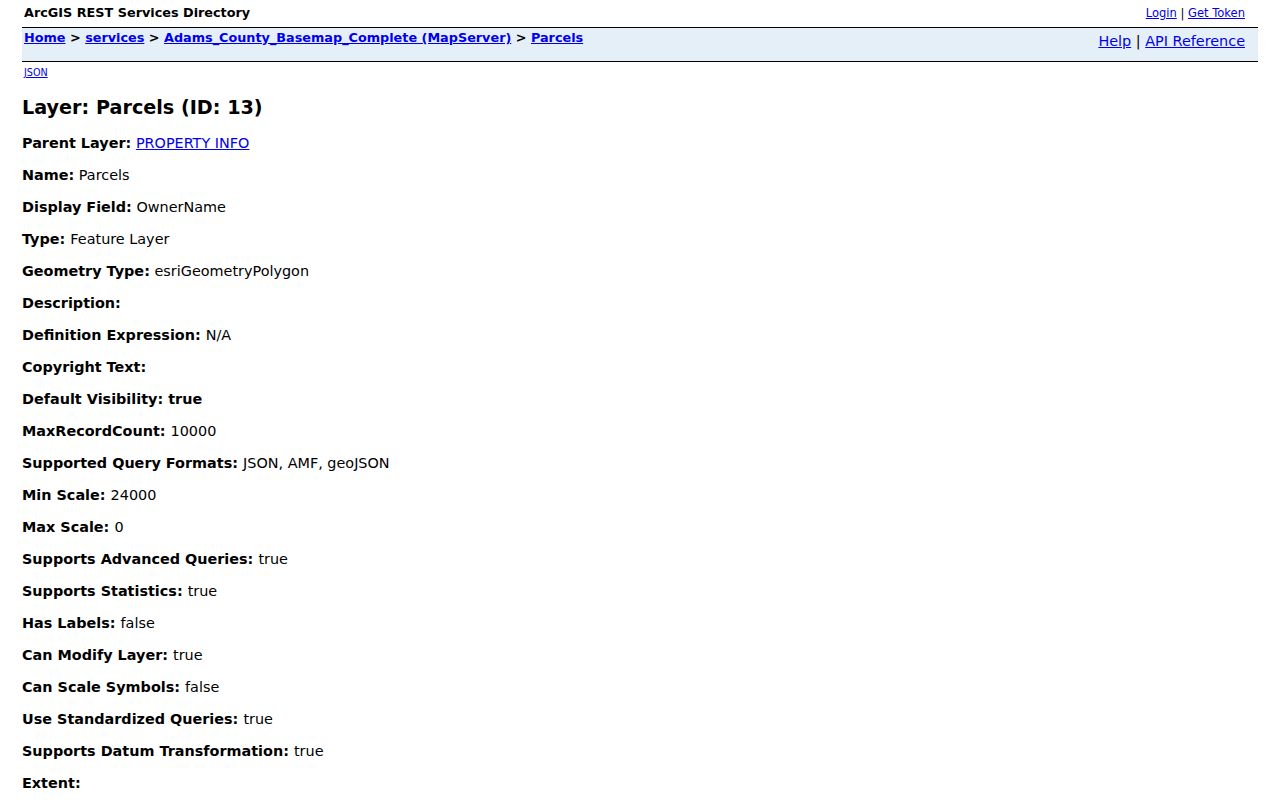
The screen makes the key distinction visible: owner and mailing columns are separate from SiteAddress and the legal land fields.
Quincy Assigns Street Addresses
Quincy Engineering assigns addresses in Quincy and Tri-Township and maintains city GIS. It is the right fallback when a new address, changed number, or road label prevents a match. Property pins are described as roughly 33 feet from the road centerline, so a map point should not be treated as a surveyed corner.
Contact Quincy Engineering at 217-228-4527 for address-assignment context. For an old street form, preserve the wording and date from the source. Then ask whether city address records or historical maps document a change. A precise Illinois Freedom of Information Act request can seek a specific address-assignment record or map if ordinary contact does not resolve it.
The Engineering office route appears below as a practical street directory fallback.
This source connects street numbering to the office that maintains Quincy address and GIS information, rather than to a general people search.
Follow Quincy Streets Into Deeds
The Adams County Recorder records deeds, mortgages, liens, plats, and other instruments. Search the Recorder's land-record routes after identifying the parcel. Tapestry supports grantor, grantee, date range, consideration, legal description, document type, and document number. Laredo, Free Data Search, office terminals, and direct office contact are other documented channels.
A grantor transfers an interest; a grantee receives it. Search the current buyer's acquisition, then search that seller as an earlier buyer. Repeat while checking the same legal description. Tapestry charges $8.75 for an index and image search. The precise start year for the county's modern online land records was not located, so do not infer that a blank result means no deed exists.
Older work moves to IRAD at Western Illinois University. The archive lists Adams County Recorder deed indexes for 1825 through 1892 on five reels and deed records for 1818 through 1927 on 106 reels. Those counts describe archival holdings, not a searchable online Quincy street directory.
Quincy Streets Before Devnet
Online tax searching stops at the 1999 boundary. Earlier Quincy tax research depends on people and physical volumes. The Treasurer can address pre-1999 records. Gardner Museum leads identify annual Quincy real-estate assessment and collection books from 1854 through 1930, except 1857, 1862, and 1881, along with other Quincy and county tax runs.
This online-versus-shelf split is one of Quincy's most useful street directory facts. A failed Devnet search for an older year is only a portal limit. Call the Treasurer, then check Gardner Museum, the Quincy Public Library Illinois Room, the Historical Society of Quincy and Adams County, or IRAD as the date demands. Record the title and year of every book consulted.
For a past occupant rather than a tax owner, use a dated street section or directory entry. The Quincy city directory collections have their own uneven year runs and access details. Do not turn a tax name into a household without another residence source.
Limits of Quincy Street Records
A Quincy street directory cannot produce a complete live roster. Parcel and deed systems can omit renters and household members. Utility customer and motor-vehicle address data are not public street lists. The Illinois Registration Lookup requires a voter's name, birth date, ZIP code, street number, and street selection for a self-match; it does not expose a browse-all block.
Even official fields need a role and date. Tax owner, deed grantee, mailing recipient, permit applicant, voter, and directory-listed resident are not interchangeable. Save the source, search terms, result date, and the exact label attached to each name. Confirm a current fact with the custodian before relying on it.
Lawful use. Use Quincy address records for personal research, family history, property study, and civic curiosity. Never use them to stalk, harass, intimidate, or harm anyone.
When an address record is missing, try the documented alternatives: the Assessor or Treasurer counter, Recorder terminal, City Engineering, a focused FOIA request, QPL, HSQAC, Gardner Museum, or IRAD. A gap should narrow the next question, not support a claim that no record or resident existed.