
Finding Residents Across Quincy Records
Begin with the item already known: a surname, house number, phone number, record type, or rough year. Adams County does not publish one browse-all list of Quincy residents. The practical route is to test the same name or place in records created for separate public purposes. A tax roll links an owner to a parcel. A deed index links parties to a recorded instrument. A city directory gives a dated household or work entry. Court, vital, business, and unclaimed-property indexes can add a second time-and-place point when their access rules fit the search.
Keep each role in its lane. An owner may receive mail elsewhere. A business officer may work in Quincy but live outside the city. A person named in court is a case party, not automatically a local resident. Renters and other occupants may never appear in a parcel record. Record the source date and the role it proves before joining two matches. That simple habit prevents a common-name match from becoming a false identity claim.
If the known item is a surname, start with the most likely time period. Current names may be checked in property, court, business-role, professional-license, or I-CASH indexes. Historical names are better tested in city directories, newspapers, vital indexes, census schedules, cemetery files, and probate records. For an address, preserve the house number and street wording exactly as the old source prints them before normalizing the location. Quincy ZIP geography and public-record coverage changed over time, so a modern spelling or postal code can hide a sound older match.
- Search the county property roll by a parcel number, owner name, or a short address.
- Use the Illinois voter tool only to check your own registration match.
- Follow an owner name into the Recorder's deed and lien routes.
- For an older Quincy household, check city directories and newspapers at the library.
- Ask the custodian for a dated, existing record when the online route is incomplete.
For a whole named road, the Quincy street directory explains the address-first chain without turning parcel owners into presumed occupants.
When no portal answers the question, use the fallback that matches the source. Visit or call the record counter, send a mail or email request, ask Quincy Public Library or the Historical Society for research help, or identify an IRAD series. Illinois FOIA can reach existing, non-exempt government records, but it does not force an office to answer a research question or open a record made confidential by another law.
Quincy Resident Records Desks
Three Adams County functions provide the clearest starting map. The Recorder of Deeds keeps deeds, mortgages, liens, plats, and other recorded instruments. The Supervisor of Assessments and Treasurer connect current tax records to parcels through Devnet. The County Clerk handles elections, vital records, assumed names, and county FOIA routing. They share the 507 Vermont Street government building, but their indexes do different work and their access rules are not interchangeable.
The Circuit Clerk is nearby at 521 Vermont Street for civil, criminal, and probate files. Quincy Public Library's Illinois Room is at 526 Jersey Street, and the Historical Society research library is at 425 South 12th Street. Those addresses form a compact local records map, yet remote options still matter: portal searches, phone calls, email, mail forms, FOIA, and archive inquiries all appear in the source notes. Confirm hours and document readiness before traveling, especially for older court material or a reel held offsite.
Quincy Parcel Searches Start Small
The county-linked Adams County Property Tax Search accepts one or more fields. County guidance favors a parcel or mobile-home number when known. For a name search, try the last name as printed on the bill. For an address, a house number with a distinct piece of the street name may work better than a long, exact string. The "Search All Tax Years" control is useful when the task is to spot a change rather than view only the current bill.
| Devnet field | Input | Best use |
|---|---|---|
| Parcel Number | Text | Exact property key |
| Owner Name | Text | Tax-bill name search |
| House Number / Street | Text | Address match |
| Township / Tax Code / District | Dropdown | Narrow a broad result set |
| Tax Year Low / High | Year | Compare ownership over time |
| Legal Description | Text | Match land across systems |
The portal displayed an August 21, 2026 update stamp during research. That marks portal freshness, not the date each parcel changed. Its online tax run begins with tax year 1999, payable in 2000. Earlier books require the Treasurer, the Gardner Museum leads, or another archive route.
A result can include the tax owner, site address, mailing address, legal description, township, district, and tax-year material. Read the site and mailing lines separately. Adams County GIS can then connect the same place to a PIN, mapped geometry, tax code, use code, owner label, address point, and document-link field. GIS boundaries are reference data rather than a legal survey. Quincy Engineering handles address assignment and map questions, but it also warns that its city property pins do not settle a boundary dispute.
The captured property and tax search screen shows the county portal as a search form rather than a ready-made Quincy residents directory.
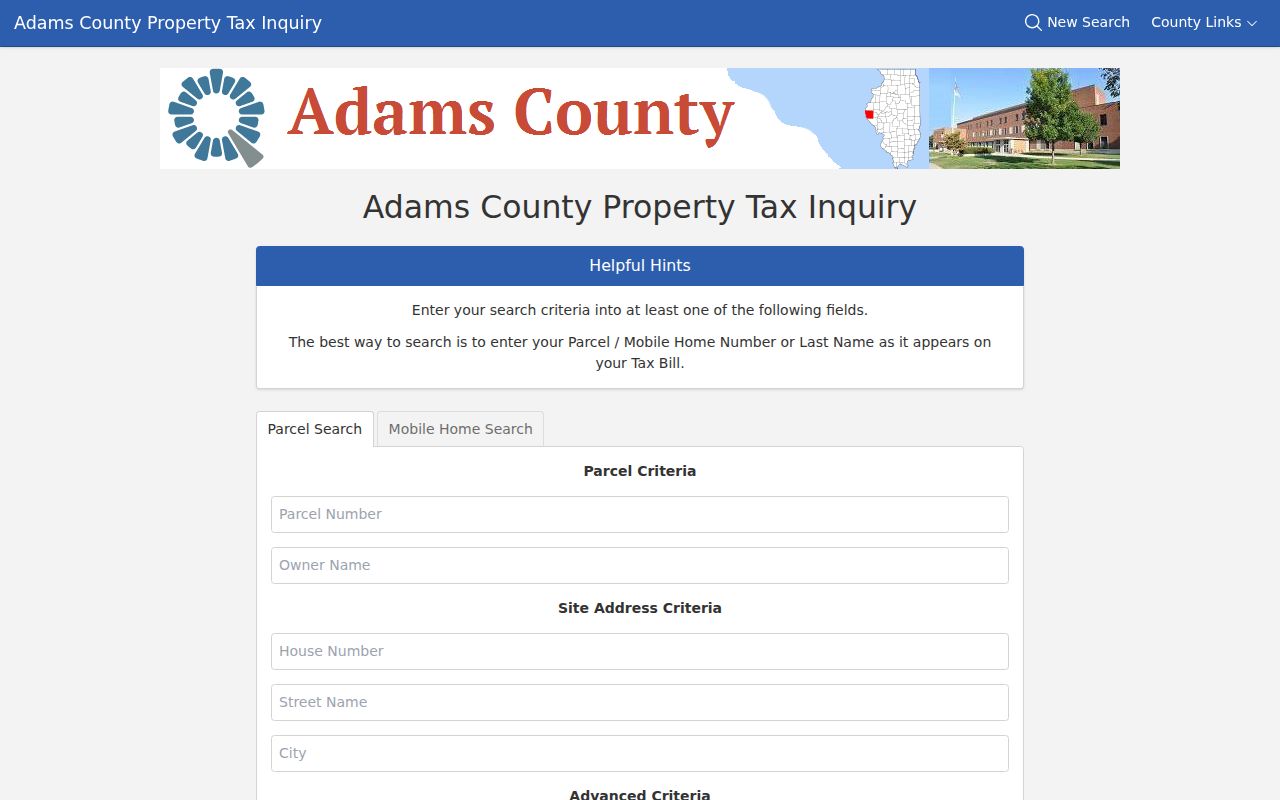
Its separate owner, address, parcel, legal-description, and tax-year fields help keep a place match distinct from an occupant claim.
Quincy Deeds Need Two Routes
The Adams County Recorder land-record page directs occasional users to Tapestry, regular users to Laredo, and basic index work to Free Data Search. The courthouse office remains an access channel when a web product does not reach the needed year or image. Search a grantor, the person giving an interest, and a grantee, the person receiving it. Then match the document date, type, legal description, and book or page to the parcel.
- Parcel
- A mapped unit of land identified by a PIN.
- Index
- A finding list that points to a document; it is not always the document image.
- Grantor and grantee
- The parties giving and receiving the recorded interest.
- Criss-cross directory
- A printed directory arranged by street address instead of surname.
Older Adams County work also runs through IRAD at Western Illinois University. Its holdings include deed indexes from 1825 through 1892 on five reels and deed records from 1818 through 1927 on 106 reels. Those ranges are archive holdings, not a promise that every image is online. Phone or write the Recorder or IRAD when the index, film, certification, or copy status matters.
Tapestry is the Recorder's pay-as-you-go browser route. Research records a charge of $8.75 per index and image search, with grantor, grantee, date span, consideration, legal description, document type, and document number among the described keys. Laredo is aimed at consistent users. Free Data Search offers party-name data without images. Free public terminals at the Recorder's office provide another channel. A search hit should be followed to the recorded document when its exact legal effect matters.
Property owners can also enroll in the county-linked Property Fraud Alert. It sends notice when a matching name appears in a newly recorded document. The alert is a prompt to inspect the filing, not proof of fraud and not a title-monitoring guarantee. Verify a suspicious item through the Recorder's published contact rather than a phone number supplied by an unexpected caller.
Illinois Voter Lookup Is Personal
The Illinois Registration Lookup checks a person's own registration. It asks for first name, last name, birth date, and ZIP, followed by street number and street name. It is not a public browse-all roll and should not be treated as one. Adams County election staff handle registration, address changes, and election records through the Clerk.
Illinois law permits controlled access to certain voter-list data, with redactions and purpose limits. The statewide computerized file follows a separate request process for registered political committees or a bona fide political purpose. It does not turn the self-check form into a neighbor or resident search. For a dated election record, contact the County Clerk and describe the record, election, and format sought.
The statutory safeguards are practical. Public versions redact street numbers, birth dates, phone numbers, Social Security numbers, identifiable parts of email addresses, and sensitive information. Access also tightens around an election. Quincy researchers should use election results and historical election material for civic or family-history questions without trying to defeat those protections. The county publishes election-result links reaching back to 1896, which is a different resource from the personal registration checker.
Current Quincy Directory-Like Rolls
A current Quincy residents directory is best understood as a set of role-based indexes. None covers every household. Choose the roll whose public purpose matches the question, and read its date before relying on it.
| Source | Who It Lists | Keeper | Access |
|---|---|---|---|
| Property tax roll | Tax owners and parcels | Adams County | Free portal |
| Registration self-check | The searching voter | Illinois elections | Controlled self-match |
| Recorder index | Parties to recorded instruments | Recorder of Deeds | Free and paid routes |
| City staff directory | Public staff and departments | City of Quincy | Free online |
| I-CASH | Reported property owners or heirs | Illinois Treasurer | Free name search |
The property roll answers who is taxed for a parcel. The Recorder shows who appears on a deed or lien. The staff directory identifies a public employee in an official role. I-CASH can give an heir or owner a lead, but a claim requires proof of the relationship. To verify one named person across these roles, use the Quincy resident lookup workflow.
Official rolls tend to disclose the source, keeper, role, and date. Commercial people-finding tools may blend old addresses and names without showing how a match was made. That makes an official index slower at times but easier to check. Free access also varies: Devnet and the city staff directory are open, Free Data Search omits deed images, Tapestry charges per search, and certified copies carry separate office rules. Pay only through an office or service reached from an official page.
Quincy City Staff by Department
The Quincy municipal directory publishes staff names, position titles, departments, email addresses, and phone numbers. It is useful when a resident needs the clerk, engineering, planning, inspection, or another office. It is not a directory of private households. Engineering assigns new addresses for Quincy and Tri-Township areas, while Inspection and Enforcement handles permit, building, maintenance, and nuisance records.
The captured city directory screen shows how Quincy groups public contacts by their government roles.
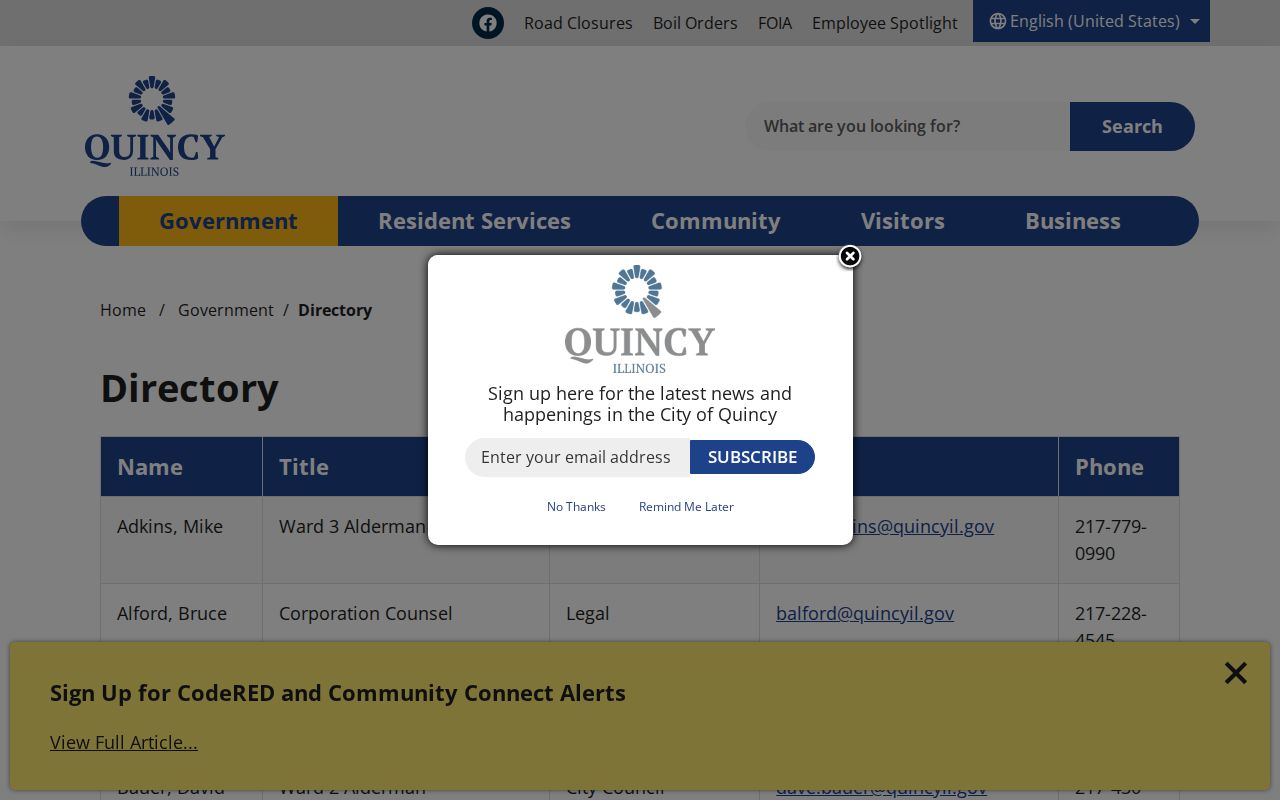
Use the department and title to route a records question, then ask for a dated existing record instead of asking staff to research a private person.
The City Clerk at 730 Maine Street handles municipal licenses, code, and records routing. The city's permits and licensing page describes an iWorQ path for permits, inspections, results, and code searches, but the dynamic destination did not expose its current fields during research. Inspection and Enforcement can answer address-keyed permit or property-maintenance questions by phone or email. Such records may name an applicant, owner, contractor, inspector, or complainant. None of those roles alone proves who lived at the address.
Quincy Courts Require Date Checks
The Adams Circuit Clerk links to Judici for county case searches. Research found working Adams County coverage from 1987, while older cases with later activity may also appear. The live form was protected by hCaptcha, so its exact current fields should be checked on the portal rather than guessed. For files before 1960, call the Circuit Clerk first. Public computers at the Adams County Courthouse provide another route.
Recent nonconfidential Illinois court documents may also be available through re:SearchIL under the statewide remote-access rules effective in 2025. Federal cases for Adams County use PACER for the Central District of Illinois. Sealed or impounded records do not become public merely because an index exists. A party-name match proves a case role on a date, not a Quincy home address.
Probate can be especially useful for an heir or family historian because a case may connect a decedent, representative, will, estate, and claim. Access still depends on the file, date, and restrictions. The Circuit Clerk says pre-1960 research should begin with a call so archived material can be prepared. IRAD catalogs older probate and court series, while newspapers, death indexes, cemetery sources, and I-CASH may provide the clues needed to identify the right case.
Quincy Records Change on Schedules
Current sources do not all refresh at the same pace. The county jail describes its Daily Population Sheet as an early-morning snapshot that may be wrong later that day. The Illinois State Police says its statutory registry updates daily. Most IDFPR license data updates daily, while bulk reports are weekly and a new license may take a day to appear. I-CASH says its claim search updates weekly. These are distinct public roles, not parts of a single residents directory.
| Source | Time warning |
|---|---|
| Adams County jail list | Early-morning snapshot; verify same day |
| ISP statutory registry | Daily updates stated |
| IDFPR license lookup | Most data daily; new issues can lag |
| Illinois I-CASH | Updated weekly |
A date label is part of the evidence. Save the portal name, access date, displayed role, and official office that can confirm the status.
The same caution applies to professional and business records. The Illinois Secretary of State search can identify a registered agent, officer, manager, filing number, or entity date. IDFPR verifies a regulated license and status. These are public-facing roles, not private residence statements. If a Quincy name appears in either source, compare it with another dated official record and never infer an address that the result does not disclose.
Quincy Vital Records Have Gates
The Adams County vital-records desk states that county birth and death records begin in 1878 and marriage records in 1825. Genealogy access uses separate age thresholds: 75 years for birth records, 20 for death records, and 50 for marriage records. A requester may need identification, the required relationship or proper interest, a completed form, and the stated fee. An index lead, a genealogy copy, and a certified certificate are distinct products.
County forms support in-person and mail paths, with online ordering for some certificate types. The genealogy index can be searched at the Clerk's counter on weekdays during its stated 8:30 a.m. to 4:30 p.m. access window. Illinois Department of Public Health provides statewide birth and death routes when appropriate, while pre-1916 work often turns back to the county or IRAD. IDPH says vital certificates are not obtained through FOIA, so a records request cannot bypass the Vital Records Act or eligibility rules.
Quincy Heirs Can Check I-CASH
The Illinois Treasurer's I-CASH is a free official route for an owner or heir looking for unclaimed property tied to Quincy. Search fields include a last or business name, first name, city, ZIP, or property ID. A match is only the start. Continuing a claim requires proof of identity and, for an heir, documents showing the relationship to the listed owner. The Treasurer says the search is updated weekly and places no deadline on a valid claim.
Pair the I-CASH name with probate, a death index, an obituary, cemetery material, or a vital record before assuming two same-name people are one person. Adams County probate starts with the Circuit Clerk, and older holdings may require IRAD. Quincy newspapers and the library's genealogy files can supply a date or relative needed to choose the right estate. This route serves a real family need without exposing a broad roster of private households.
Verify Quincy Record-Based Calls
Public facts can make a false demand sound real. Adams County warned in 2025 about callers who used arrest or warrant themes and pressed people for payment. A name, parcel, court reference, or other public detail does not prove the caller represents the county. End the call. Find the office number on the official Adams County, City of Quincy, or Illinois agency website, then ask the office to confirm the claim through its own record system.
Payment pressure is a reason to pause. Do not trust a callback number, payment link, gift-card request, or account supplied in an unsolicited message. Save the date, claimed office, caller number, and words used without disclosing more personal data. For a suspicious recorded instrument, contact the Recorder and inspect the filing. For a court claim, contact the Circuit Clerk. For a state license or business role, reopen the official state portal from its agency page.
Historical Quincy Directory Shelves
The Quincy Public Library Illinois Room keeps city directories, microfilm, yearbooks, local histories, newspapers, and genealogy sources. Holdings are described as reaching from 1848 to current years in an uneven run, so confirm the needed volume before a visit. The Historical Society of Quincy & Adams County adds property, architecture, deed, map, photo, and family-history files. IRAD holds older city and county government series when a printed directory does not survive.
A directory entry is a dated clue. It may show a name, occupation, spouse, employer, boarding status, or residence line. Publication lag matters: a local 222 S 16th Street house history found a 1906 entry that still listed William Bull after its source placed him in Chicago. Pair the entry with a newspaper, deed, tax record, census year, or vital index. The full shelf and abbreviation method belongs in the Quincy city directory collection guide.
Call or email before asking for a volume because the run is described as various years rather than unbroken annual coverage. In the room, read the abbreviation key first and check both surname and address arrangements when available. Search a year before and after the target date. Yearbooks, local histories, government documents, obituary and clipping files, and newspaper microfilm can separate two people with the same name. The historical society can add architectural files, maps, photographs, property notes, and family-history material.
Quincy Newspapers Fill Date Gaps
The library's Illinois Room bridges printed volumes with newspaper microfilm and local indexes. Its historical newspaper archive describes digitized Quincy coverage, while the live archive displayed a custom 1838 to 2021 range during the 2026 inspection. Search names with an address, spouse, firm, school, church, or event. OCR can miss old type, so browse nearby dates and page images when a clean surname search fails.
The captured Illinois Room collection page points to the local materials that support a residents directory search.
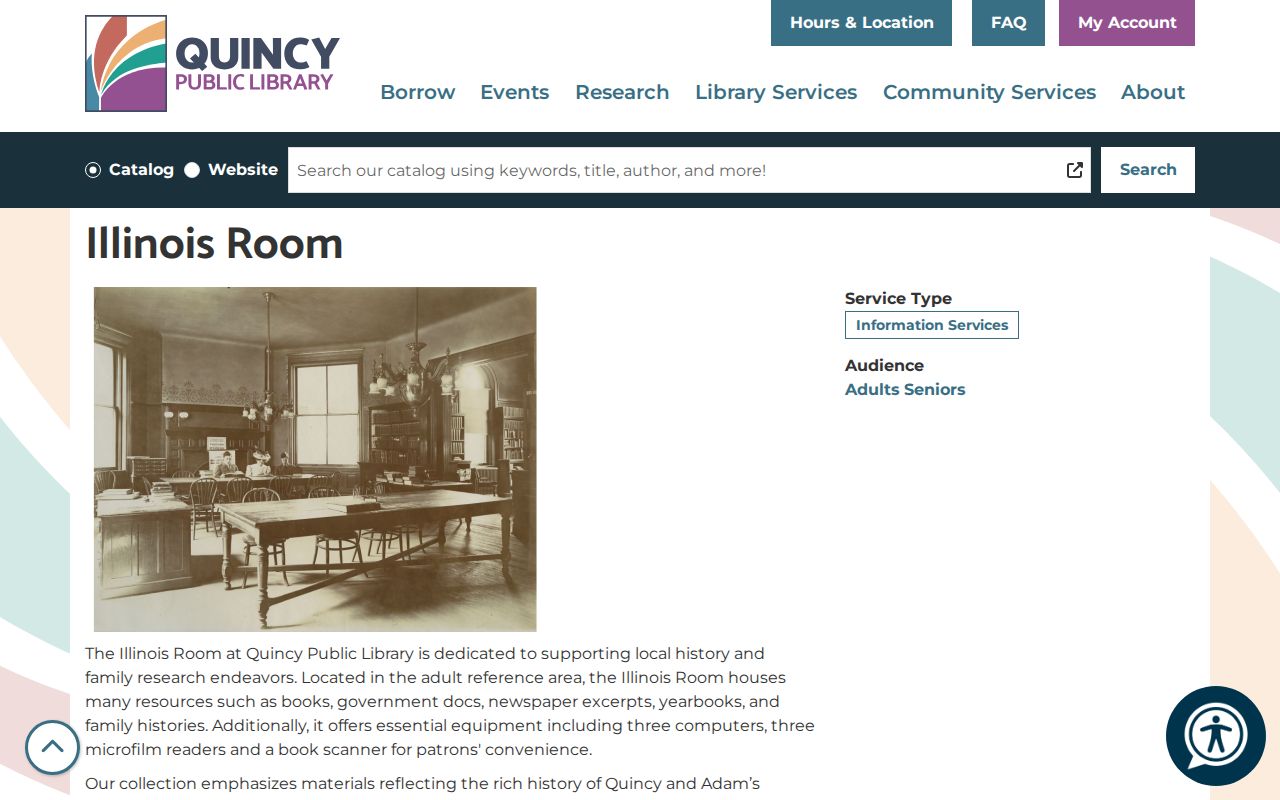
Directories supply the dated address; newspapers and local files can explain why the name appears there and whether a move or life event changed the trail.
Digitized does not mean complete. The live Quincy newspaper archive showed a large page set for 1926 through 2021 and a broader custom date control, but issue counts, OCR quality, and image availability vary. Try initials, alternate spellings, a spouse, a firm name, and a street. If the web search remains blank, library staff can help with microfilm and indexes that are not exposed as a public name database.
The 1835 Quincy Record Break
A December 9, 1835 courthouse fire caused some Adams County records to be lost or damaged. That event changes early Quincy research. A blank result near the fire is not proof that an event never occurred, and it should not be labeled destroyed unless a repository says so. Use IRAD's county inventory, deed transcriptions, land patents, probate, newspapers, tax leads, church sources, cemetery records, and city proceedings as alternate paths.
IRAD lists Quincy ordinances from 1834, city council minutes from 1839, council proceedings beginning in 1831, election papers from 1845, and street assessment records from 1853. These civic records may place a person in public or property context without acting as a household directory. Ask the repository about the exact series, year, format, and reproduction terms. Local librarians and historical society staff can then cross-check names that changed spelling or streets that changed description.
Later sources can help work backward toward the gap. Start with the most recent proved person-place-date link, then move through directories, deed indexes, tax books, probate, vital indexes, census schedules, maps, and newspapers. Preserve every negative result with the repository and coverage range checked. A failure in one index may mean a spelling shift, missing volume, offsite reel, changed jurisdiction, or a record type that was never created.
Note: A missing online hit is a research lead, not proof that the Quincy record or person did not exist.