
Quincy Directory Collections by Era
The Quincy city directory shelf begins in the nineteenth century, but it is not one unbroken annual run. A library survey describes Quincy volumes from 1848 to the current era in various years. That wording matters. It does not promise that every edition, publisher, or street index survives. Researchers should ask for a specific year and inspect the title page, edition statement, publisher, alphabetic section, street section, and abbreviation key before taking notes.
| Quincy collection | Years or span | Keeper | How to use it |
|---|---|---|---|
| City directories | 1848-current, various years | Quincy Public Library Illinois Room | In-room research; confirm each edition and gaps |
| Reverse or criss-cross volumes | Exact run not published | QPL or HSQAC shelf inquiry | Ask staff whether an address-order volume exists |
| Historical newspapers | 1835-current on microfilm; digital ranges vary | QPL readers and online archive | Search a name, address, date, or local term |
| Local and house histories | Including 1879, 1905, and address files | QPL, HSQAC, architecture archive | Onsite files and repository rules apply |
| Yearbooks and local indexes | Years vary | QPL Illinois Room | Compare names, schools, cemetery and census indexes |
| Fire insurance maps | 1880-1920, various years; 1883 online | QPL, HSQAC, Library of Congress | Check buildings and street context, not occupancy alone |
No authoritative current source gave a complete publisher-by-year list or shelf call numbers. Record missing editions as gaps instead of filling them from memory. State and federal catalogs, Google Books scans, FamilySearch, NARA, and the Illinois Regional Archives Depository can extend a search, but none replaces a check of the Quincy shelves.
Quincy Directory Work at QPL
The Quincy Public Library Illinois Room at 526 Jersey Street is the main local workbench. Its listed hours are Monday through Thursday, 9 a.m. to 8 p.m., and Friday and Saturday, 9 a.m. to 5 p.m. The room is closed Sunday. Call 217-223-1309 when a trip depends on a certain year. Librarians can meet by appointment, and Genealogical Society volunteers are available Tuesdays from 10 a.m. to noon without an appointment.
Three computers, three microfilm readers, and a book scanner support work across formats. The holdings include city directories, school yearbooks, microfilm, local histories, letters, organizational files, government documents, vital and cemetery references, census and early indexes, and Herald-Whig clippings. Ancestry access is available on a library computer, not as an unrestricted remote subscription. If the directory year is absent, staff can help shift the search to a newspaper, yearbook, index, or local-history file.
Ask for the volume by year, photograph its title and abbreviation pages when permitted, and note whether it covers only the city or also county and business listings. Those small checks prevent a name from being assigned to the wrong edition.
Note: Call ahead when one Quincy directory year is essential, because “various years” describes a collection span rather than a complete run.
Decode a Quincy Directory Entry
A historical listing may combine a name, work role, firm, and residence line in a few clipped words. The conventions change by publisher and year. Transcribe the whole line first. Then decode it with the key printed in that edition. Do not add a spouse, owner status, or renter status unless the volume itself supplies that fact or symbol.
| Name | Surname, initials, spelling variant, or a widow notation when printed |
|---|---|
| Role | Occupation, agent, proprietor, or business connection, which may not be a household role |
| Residence | A house number, street, corner, side of street, boarding place, or post-office reference |
| Local shorthand | res means residence, cor means corner, bet means between, and ss/ns marks a street side |
| Date | The edition or publication year, which can lag a move or death |
The 1871-72 form “Adams ss 1 e Sixth” is a location clue: Adams Street, south side, one place east of Sixth. It should remain in the notes beside any modern interpretation. The local 608 Adams research also shows “Jn Neumann” and later “Joseph Newman,” a reminder to search initials and anglicized spellings.
- Criss-cross directory
- A later address-order section used to move from a street address to a printed name.
- Householder index
- A publisher's list organized around household names or addresses; its exact fields must be checked in that volume.
- Abbreviation key
- The edition-specific legend that explains short forms and symbols. Copy it before interpreting entries.
Quincy Newspapers Fill Directory Gaps
The QPL historical newspaper archive describes online Quincy papers from 1835 through 2020 and allows searches by date, name, or keyword. Results can be viewed, printed, saved, or emailed. Named starts include the Illinois Bounty Land Register in 1835, Quincy Whig in 1838, Quincy Herald in 1848, Evening Call in 1870, Quincy Journal in 1883, and Quincy Herald-Whig in 1926.
The live digital archive displayed a custom range of 1838-2021 during the August 23, 2026 inspection. Its 1926-2021 group showed 819,934 pages. That large number is useful, yet digitized does not mean complete. A missing hit may reflect OCR errors, an absent issue, a title change, or an image gap. Search the surname with a street, school, church, cemetery, railroad, brewery, ward, or organization.
Review the date groups on the Quincy Public Library digital archive search screen.
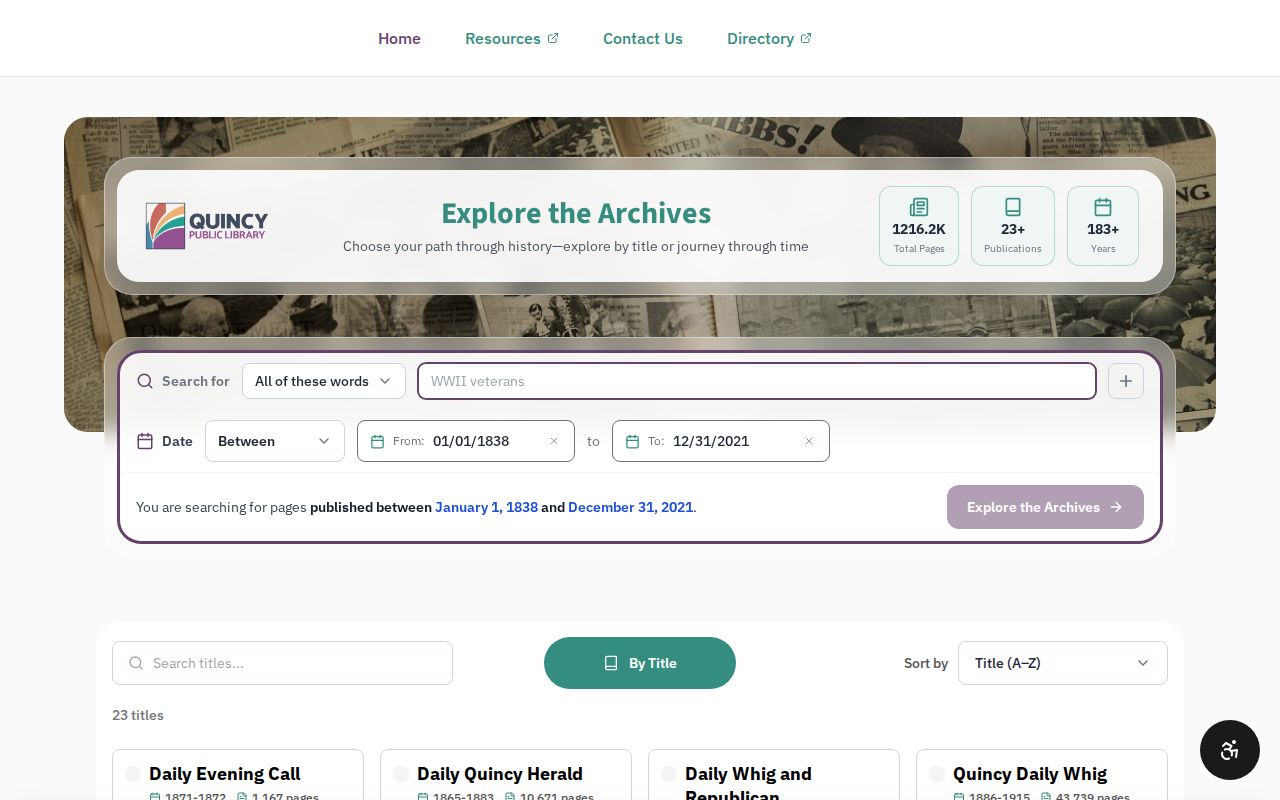
The screen shows why a directory listing can be tested against a dated article instead of being read as a timeless resident record.
Quincy Listings Can Lag Moves
A Quincy city directory captures information collected for an edition, not a live status. The local history for 222 S 16th Street gives an unusually clear warning. It associates the William Bull family with the house around 1887 and places William in Chicago in 1898, yet a 1906 directory still listed him. The listing is real evidence, but it does not establish that he remained at the Quincy address through publication.
Use editions on both sides of a suspected move. Then check a census, newspaper notice, deed, tax book, cemetery record, or probate file. A disappearance has several possible meanings: the person moved, died, changed name, was omitted, or appeared under initials. Publication lag is a local reason to avoid treating the first or last printed appearance as an exact arrival or departure date.
Quincy Directory Clues at HSQAC
The Historical Society of Quincy & Adams County Research Library adds property and family context that may never appear in a city directory. Its second-floor library at 425 S 12th Street is open Tuesday through Friday from 10 a.m. to 2 p.m., with an appointment recommended. The society reports more than 20,000 local-history items and over 6,000 catalog records, including deeds, maps, photographs, diaries, architectural drawings, tax and property inventories, and genealogy material.
Materials remain onsite. Phone and email questions are free, while copies require permission and a per-page fee. The stated nonmember research rate is $15 per hour, including postage for one letter-size envelope and up to six photocopies. Call 217-222-1835 to confirm the policy and the file before visiting. One search lead names a cabinet, “Residences North 8th to North 90th,” but staff should confirm its present location and contents.
The society's research page describes the local archive and its access terms.
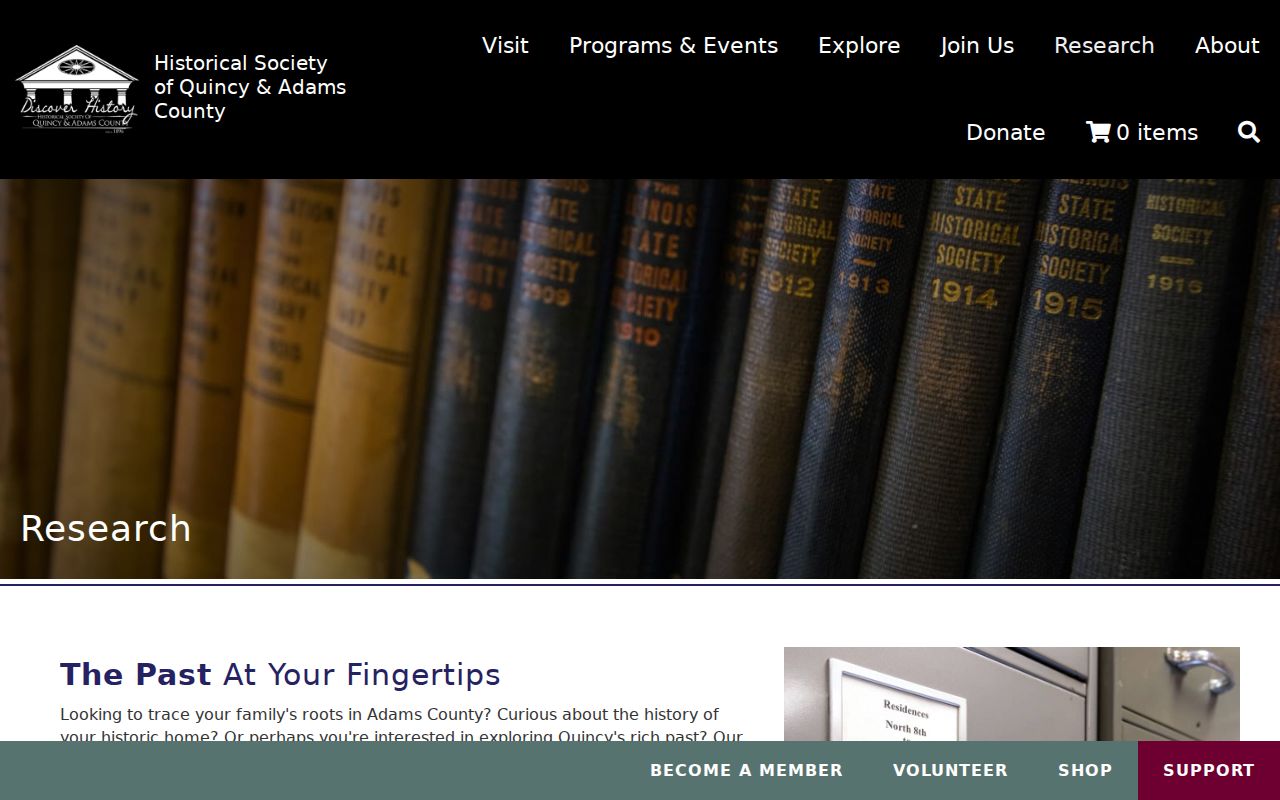
This collection can connect a terse directory address to maps, photographs, property files, or an architectural record.
Trace Families Through Quincy Directories
Begin with a person and a rough date, not a claim that every edition exists. A careful sequence keeps names, addresses, and source limits visible while it bridges the ten-year space between federal census schedules.
- Search the closest available Quincy edition for the surname, initials, married name, and likely spelling variants. Copy the full entry and edition details.
- Check the prior and next available volumes. Record address, work role, spouse or widow notation, and each gap without guessing.
- Use an address-order section only if that edition contains one. Compare nearby names, but do not turn them into family members without another record.
- Pair the sequence with the 1850, 1860, 1870, 1880, or 1900 census route that fits the date, then test the household with newspapers.
- Close the trail through cemetery, death, vital, probate, tax, deed, yearbook, or architectural files held by the proper custodian.
The IRAD Adams County inventory supplies deed, probate, vital, court, city, police, jail, and election series when the Quincy shelf is not enough. Repository and reproduction rules apply. For a modern person rather than an historic household, move to the Quincy resident lookup workflow instead of stretching an old listing beyond its date.
Quincy Directory Evidence Over Time
Quincy became the Adams County seat in 1825 and incorporated as a city in 1840. Its growth from fewer than 7,000 people in 1850 to about 24,000 in 1870 helps explain why directories, census rolls, tax books, and newspapers become especially valuable during those decades. The timeline below marks evidence points, not a claim of annual publication.
| Date | Quincy research milestone |
|---|---|
| 1835 | The courthouse fire damaged or destroyed some early county records, increasing the value of library and IRAD cross-checks. |
| 1848 | The described Quincy city directory span begins, with various years rather than a proven complete run. |
| 1883 | The Library of Congress Quincy Sanborn edition provides 22 sheets of building and street context. |
| 1889-1899 | The 608 Adams bibliography cites a directory run used with deed, tax, and map evidence. |
| 1999 onward | County tax years move online through Devnet; older physical sources remain relevant. |
The December 9, 1835 fire is especially important for early families. An empty county index is not enough to show that an event never happened. Land patents, deed transcriptions, newspapers, probate, cemetery material, tax sources, and later directory references may supply the missing bridge.
A Quincy Address Across Sources
The local 608 Adams landmark study shows how one address can join many records without turning any one source into a complete biography. It cites directory and deed research from 1859-1872, “Jn Neumann” near Sixth in 1871-72, Joseph Newman at 608 Adams in 1887-88, and directories from 1889-1899. It also cites tax records, Sanborn editions, and a June 28, 1900 event in Deed Book 299, page 88 involving John Newman's heirs.
Each item has a distinct purpose. The city directory ties a printed name to a dated location. The deed describes a title event. Tax books identify assessed interests. Sanborn maps show building and lot context. A death or probate source may explain heirs. The original deed image, complete parties, individual directory pages, tax pages, and map sheets still need inspection before the chain is treated as complete.
This source trail is a sound model for Quincy genealogy: quote the old address form, retain name variants, cite the edition, and say what remains unverified. The 1883 Quincy Sanborn collection can add physical context, but a map cannot name an occupant by itself.